

 |
Centre
for Ecology, Development and Research (CEDAR)
CEDAR
is a not for profit organization registered in 2006 under the Societies
Act of
1860. The registered office of CEDAR is located in Delhi while the main
operations
office is based in Dehradun. CEDAR was established when a group of
academics
and development practitioners came together to bridge the gap between
applied
research and field based interventions or, to put it differently, ‘balance
theory and practice’. The
development sector has, for long, been caught in the divide between
theoreticians and practitioners. This divide has set the sector back
and
deprived it of the opportunity to continuously assess and improve its
work.
This has also had implications for policy formulation whereby the lack
of a
right blend of lessons from the field, properly documented and
analyzed, has
led to information gap in policy formulation. CEDAR sees its role to
straddle
this divide and help fill the information gap in policy formulation.
The research
activities of CEDAR essentially focus on generating, monitoring and
interpreting socio-ecological field-data that can improve the
management of
natural resources. Central to CEDAR’s ideology is the recognition
that local
communities must participate in conservation. Therefore, in addition to
building core research competence in forestry, ecology and social
sciences, the
organization works towards strengthening links between communities and
ecosystems by networking with grass-root organizations.
Website: http://www.cedarhimalaya.org
Possible volunteering opportunities
Students
can volunteer in a number of projects conducted by CEDAR,
details of which are given below:
1.
Understanding the impacts of Climate change and Forest Degradation on
Carbon stocks and population dynamics in the Oak zone of the Central
Himalayas
The
study aims to better understand the functioning of the central
Himalayan forest ecosystems and its response to climate change and
chronic
human disturbance. Estimating the shift in altitudinal zones of
important tree
species due to changes in climate is important to be able to predict
the future
composition of forests and their utility to local people. Mountains are
a
suitable habitat to study the altitudinal shifts of sedentary life
forms such
as trees as a result of climate change. Rapid changes in climatic zones
due to
altitude make the process of study of a shift in ecological zones less
dependent on random factors.
Concurrently,
better estimates of carbon sequestration rates,
particularly in disturbed zones, will greatly enhance our ability to
provide
accurate carbon data for the Himalayan forests. This assumes great
importance
as a result of REDD+ which is currently being debated in the
International
arena. Finally, permanent plots have largely not been established for
the
central Himalaya. Early plots established by the forest department to
look into
growth rates do not focus adequately on regeneration and the impacts of
human
disturbance, and this study aims to establish plots that take into
congnizance
a range of disturbance regimes that typify the Himalayan forests today.
2.
Standardising a technique for the rapid and accurate measurement of
Carbon assimilated by Himalayan forests
Leaf
area index (LAI) is a measure of the total leaf area in a given
unit area. It can be estimated by using
certain simple to use devices. Research
has shown that LAI is very closely correlated to estimate tree growth
and
carbon sequestration. Research done by
CEDAR researchers has found this relationship to work very accurately
for
Himalayan forests and it is able to easily capture the effects of
forest
degradation (lopping of trees) and site quality.
This
project will aim to develop standard values between LAI and carbon
sequestered for various types of Himalayan forests (oak, pine and sal). LAI will be measured using a LAI-meter. Traditional measurements of biomass increase
will be made through accurate measurements of tree diameter at one year
intervals. The relationship between LAI
and biomass increase will be worked out for various forest types in the
Himalaya as standard tables.
3.
Assessing the impact of fodder development on forest and livelihoods
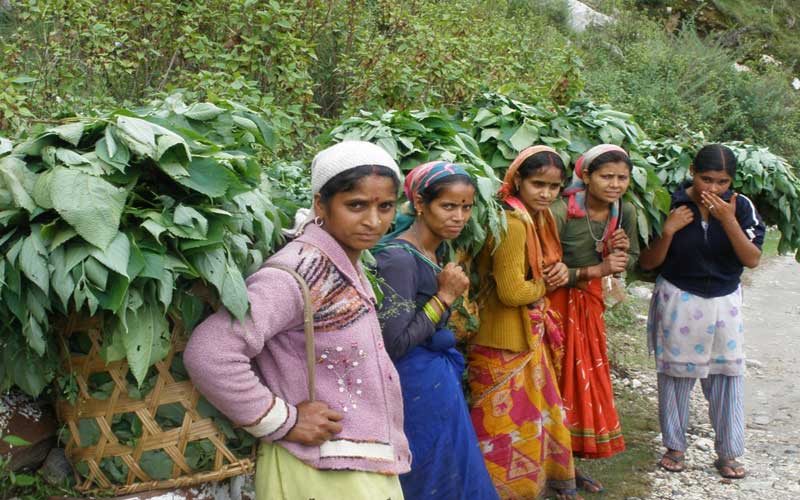
in central Himalaya
In the
densely populate mid-elevations of the central Himalaya
(1600-2200m) tree leaves, mainly from banj oak (Quercus
leucotrichophora),
constitute the main source of green fodder for cattle during the winter
and
spring season. From December to May, the
availability of grasses and other fodder is sparse and the leaves of
banj are
lopped from trees and fed to cattle.
This lopping of green leaves is the single greatest
cause of forest
degradation in the Himalaya. Trees are
pruned and loose most of their branches assuming a
‘telephone-pole’ like
morphology. The tree, depleted of over
90% of its leaf and branch biomass, gradually looses the ability to
produce
enough photosynthate to sustain its critical life support activities
and
becomes susceptible to disease, drought or other factors which
eventually cause
its mortality.
Programmes
to grow a variety of fodder grass, many of which stay
evergreen and others which provide sufficient nutritious dry fodder to
last the
winter have been piloted over the past several decades.
The
study attempts to determine the impact of the fodder programme on
both the lives of local people and on ecosystem recovery. Socioeconomic
surveys, to monitor impact on women and cattle; and forest sampling to
determine growth rates of tress in forests subject to lopping are the
tools
used to determine the impacts of the fodder programme.
4.
Assessing the Ecosystem Services flowing from the Himalayan Mountains
This
would be a project based largely on secondary data.
Students would be supervised by Prof
S.P.Singh, the Chairman of CEDAR and would be encouraged to develop a
report on
Himalayan ecosystem services. The region
is an important contributor of ES and water and sediments flowing from
these
mountains help sustain the billion or so people living in the Indo
gangetic
plains. As development of infrastructure,
migration from rural to urban areas and forest degradation occur, there
are
changes in the quantum and flow of ES from the region.
Assessing these changes, based on available
literature (and some speculation) on
various changes occurring would help develop an understanding of
ecosystem
services. While some level of
quantification will also be encouraged, this would be the secondary
objective.
Preferred skills
Open to
students with both social sciences and natural sciences
backgrounds.
Students
would be encouraged to spend a good part of their time in the
field, making measurements and learning about the ecosystems where they
are
working. Work will be supervised by the
Executive Director of CEDAR (Dr. Rajesh Thadani) and the Coordinator of
CEDAR
(Dr. Vishal Singh).
Approximate cost
£1400
for eight weeks, including flights (costed at £500, to be booked
by volunteers), visa costs, board and lodging, local travel and Camvol
administrative fee.
NOTE:
Estimated
costs for
placements assume that flights to India are £500. However,
applicants should note that flight costs can vary greatly depending on
airlines and time of bookings, and adjust their budget estimates
accordingly. Similarly, vaccination costs have NOT been included in
estimated costs, and applicants should take this into account while
planning their budgets.
|
 |